The Letter in the Mail.
It usually arrives on a Tuesday. A standard white envelope. No urgency markings. Inside, the language is polite but final. “After a recent review of your account activity, we have decided to discontinue our relationship.” There is no appeal process. There is no phone number for a case manager. Just a check for the remaining balance and a 30-day notice to leave. This is not a mistake. It is a trend.
In 2026, banks are not just managing risk. They are shedding it. And if you are a foreign owner of a US LLC, you are the weight they are dropping.
The Profitability Equation
SO, to understand why, you have to ignore the “customer service” brochures. Look at the P&L of a compliance department. The cost to maintain a “standard” domestic business account is low. Automated systems handle it. Therefore, the cost to maintain a “foreign-owned” business account has exploded.
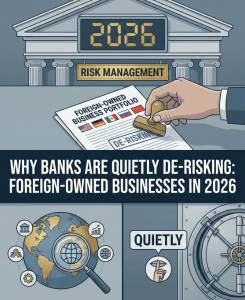
New regulations require enhanced due diligence. Human analysts must verify beneficial ownership. They must screen against constantly shifting sanctions lists. They must understand the cross-border flow of funds. That human time costs money.
But if a bank spends $2,500 a year in compliance labor to monitor an account that generates $500 in fees, the math is negative. The bank is losing money by letting you be a customer. So, they fire you.
The FinCEN Bullseye
Therefore, the regulatory landscape shifted violently in March 2025. When FinCEN issued its “Interim Final Rule,” it exempted domestic entities from certain reporting requirements. It was a relief for local businesses. But it painted a target on foreign entities.
So, now, foreign-owned US LLCs are the primary focus of the Beneficial Ownership Information (BOI) database. They are the outliers. They are the “special cases.” Banks hate special cases. Special cases require manual review.
When a bank algorithm sees “Foreign Reporting Company” status, it flags the account. It moves it from the “Safe” pile to the “High Maintenance” pile. In 2026, the “High Maintenance” pile is being shredded. For more information, check the news on FinCEN
The Algorithmic Sheriff
Decisions are rarely made by humans anymore. Your relationship manager likely didn’t even know your account was closing until the letter went out. AI models now run the “de-risking” programs. They look for patterns. High velocity of funds? Cross-border wire transfers? Login IP addresses matching high-risk jurisdictions?
If the risk score crosses a threshold, the closure is automatic. There is no meeting to explain your business model. The algorithm does not care about your 10-year history. It cares about the current risk coefficient.
The “De-Risking” Euphemism
“De-risking” is a sterile corporate term. It sounds prudent. In reality, it is a blunt instrument. It wipes out legitimate businesses alongside the bad actors. It is indiscriminate. A software company in Austin founded by a German developer gets caught in the same net as a shell company moving dark money. The bank admits this privately. They accept a certain rate of “false positives.” You are collateral damage in a war against compliance costs.
The Liquidity Trap
This creates a dangerous liquidity trap. When a primary bank closes an account, it triggers a chain reaction. Payment processors like Stripe or PayPal monitor banking status. If the underlying bank account dies, the processor freezes funds. “Risk checks.” Suddenly, revenue is stuck. Payroll is due in 4 days. The funds are there, but they are inaccessible. This is how solvent companies go bankrupt in a week.
Survival of the Boring
How do you survive this purge? You must become boring. Banks love boring. They love predictability. They love documentation that matches the activity. If your LLC is foreign-owned, you cannot afford to be casual.
- Over-Communicate: Don’t wait for the bank to ask about a large wire. Send the invoice and contract to your banker before the money moves.
- Redundancy: One bank account is zero bank accounts. You need a primary Tier 1 bank and a secondary fintech backup. Never rely on a single rail.
- Localize: If possible, hire a US-based manager with “substantial control.” It adds a layer of domestic legitimacy to the compliance file.
The New Normal
This is not going away. The compliance costs for banks are only going up. The 2026 environment is hostile to cross-border complexity. If you are foreign-owned, you are swimming upstream. You are “high risk” until proven otherwise. Accept that reality. Build your banking redundancy now.
Because the letter is already in the mail for someone. Don’t let it be you.
Disclaimer
Look, ADMIN has been doing this a long time, but I’m a strategist, not your specific financial advisor or lawyer. The markets and regulations mentioned here, like the FinCEN rules or tariff situations, change faster than the weather. This article is meant to make you think strategically, not to replace professional advice tailored to your exact situation. Always do your own due diligence and consult with qualified professionals before making major moves.