The Myth of the Free Lunch
Let’s start with the lie everyone wants to believe. You want an investment that doubles your money in a year, never goes down in value, and is as safe as a savings account. I want that too. I also want to eat pizza every day and have six-pack abs. Neither is going to happen. In finance, there is an iron law: risk and return are joined at the hip. You cannot have one without the other. If someone promises you high returns with low risk, they are either incompetent or they are trying to scam you. Run.
Understanding this relationship is the difference between an investor and a gambler. One builds wealth; the other burns it.
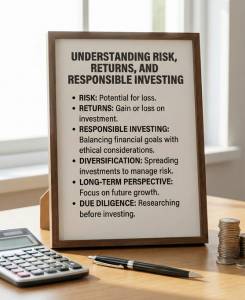
What “Risk” Actually Means
If you read a textbook, it will tell you risk is “standard deviation.” It will show you a bell curve. Forget that. That is math, not life. In the real world, risk comes in three flavors:
- The Risk of Loss:
This is the scary one. You put $10,000 in, and you get $0 out. This happens when you bet on a single speculative stock or a crypto coin named after a dog.
- The Risk of Volatility:
This is the emotional one. You put $10,000 in. Next week it’s $8,000. You panic. You sell. Two years later, it would have been $15,000. The loss wasn’t in the market; it was in your reaction.
- The Risk of Inflation:
This is the silent killer. You bury $10,000 in the backyard to be “safe.” Ten years later, you dig it up. It’s still $10,000, but it only buys $7,000 worth of groceries. You lost money by playing it too safe.
Most people obsess over #1 and #2. They are terrified of the red numbers on the screen. But for a long-term investor, #3 is the real enemy. Responsible investing isn’t about avoiding risk. It’s about choosing the right risk.
The Price of Admission
Think of returns as a fee you get paid for enduring pain. The stock market has historically returned about 10% a year (on average, over decades). That is a generous payout. But you don’t get that 10% for free. You get it in exchange for the years where the market drops 20%. That drop is the price of admission.
If you can’t handle the drop, you don’t get the gain. It’s that simple. Many people try to cheat the system. They try to jump in when it’s going up and jump out when it’s going down. This is called “market timing.”
It is a fool’s errand.
The data shows that missing just the 10 best days in the market over a 20-year period cuts your returns in half. Responsible investing means accepting the volatility. It means looking at a 10% drop and saying, “This is the fee I pay for long-term growth,” rather than screaming, “The sky is falling!”
Responsible Investing: The “Adult” Table
So, how do we invest responsibly without having a heart attack? We don’t bet on horses. We buy the track. If you want to study financial adulting, you can explore online. If you own only one company, you have a “single point of failure” risk. If the CEO tweets something stupid, you lose money.
And if you own 500 companies (like an S&P 500 index fund), one CEO doesn’t matter. Diversification is the only way to lower your risk without lowering your expected return. It is the magic trick of finance.
The Time Horizon
If you need money next year for a wedding, put it in a savings account. Investing that money is reckless.
If you need money in 20 years for retirement, putting it in a savings account is reckless (remember inflation). Responsible investing matches the asset to the timeline. Stocks are for the long run. haul. Cash is for next Tuesday.
Dollar Cost Averaging
This is the antidote to timing the market. You invest the same amount every month. When the market is high, you buy fewer shares. When the market is low, you buy more shares. You actually want the market to dip while you are accumulating. It means stocks are on sale. This turns market volatility from a threat into an opportunity.
The Sleep Test
Finally, there is the most important metric of all: the sleep test. I tell my clients this: “I can build you a portfolio that maximizes returns on a spreadsheet.” “But if you stare at the ceiling at 2 AM worrying about it, it is the wrong portfolio.”
Responsible investing is personal. If you can’t handle a 20% drop, don’t carry a portfolio that is 100% stocks. Dial it back. Add some bonds. Add some cash. You will make less money in the long run. But you will actually stick with the strategy. A mediocre strategy you stick with is infinitely better than a perfect strategy you quit in a panic.
The final advice or summary.
Stop looking for the secret. Stop looking for the shortcut. Wealth isn’t built by finding the one stock that goes to the moon. It is built by:
- Accepting that risk is the price of growth.
- Diversifying so you never get wiped out.
- Giving it enough time to work. That is boring advice. It won’t go viral on TikTok. But it works. And unlike the “get rich quick” schemes, it will still be working in 20 years.
Disclaimer
This article is for financial awareness and money management education only. It does not provide investment, legal, or tax advice, and does not
recommend any financial products. Always consult a professional before making major financial decisions. If you have any queries regarding my decision, you can contact Admin.
Note: We didn’t take a fee; this is for educational purposes only, and we also don’t advice anyone to invest on any specific platform