The Casino in Your Pocket
If you walked into a bank in 1990 to buy a stock, it was a boring process. You filled out a form. You talked to a human in a suit. You paid a commission. The environment screamed, “This is serious. Be careful.” In 2026, buying a stock feels like playing Candy Crush.
When you tap “Buy,” confetti explodes on your screen. When you check your portfolio, the numbers flash green or red like a slot machine. When you refer a friend, you get a “free stock” like a lottery ticket. This isn’t an accident. It is gamification.
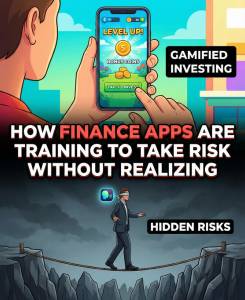
Finance apps
Finance apps have borrowed the addictive design principles of social media and video games. They have removed the friction. Friction was annoying. But friction was also safety. By making investing “fun” and “easy,” these apps have silently trained millions of users to treat the stock market like a casino. They have rewired our brains to crave dopamine hits rather than long-term compound interest. Here is how the interface itself is manipulating you into taking risks you don’t understand.
The “Confetti” Effect (Rewarding Activity, Not Outcome)
In behavioral psychology, if you reward an action, the subject will repeat it. Trading apps reward the act of trading, not the act of investing. When you buy a stock, the app celebrates. If it vibrates. It shows animations. It makes you feel like you won. It does not celebrate when you don’t trade. It doesn’t send you a push notification saying, “Great job holding that index fund for another boring month!”
For example:
The Options Churner.
I analyzed the portfolio of “Kevin,” a 26-year-old user. He made 400 trades in one year. His average holding period was 4 hours. He lost 15% of his account value. But he felt successful. Why? because the
The app constantly validated him. Every trade felt like progress. The app profited from his volume (via Payment for Order Flow). Kevin paid for the confetti with his principal.
The Risk:
You confuse activity with productivity. You churn your account, racking up taxes and spread costs, because the app is designed to make stillness feel like failure.
The “Social Proof” Trap (Copy Trading)
Humans are herd animals. We look to others to know what is safe. Apps now feature “Social Trading.” You can see what the “Top Traders” are buying. You can see “trending” stocks. This creates a dangerous feedback loop. If a stock is “trending,” it usually means it has already gone up massive amounts. It is volatile. It is expensive. By showing you this list, the app is implicitly suggesting you should buy it too. It is
leveraging FOMO (Fear Of Missing Out).
The Real Example: The Meme Stock Bagholder
Sarah saw a specific EV stock on the “Top Movers” list. It was up 40% in a day. She saw comments in the app’s social feed: “To the moon!” “Buying more!” She felt safe because “everyone” was doing it. She bought at the peak. The next day, the momentum traders exited. The stock crashed 30%. Sarah wasn’t investing in a company. She was joining a mob. And the mob always disperses when the police (or reality) show up.
The Risk:
You outsource your due diligence to strangers. You buy at the point of maximum optimism (the top) and sell at the point of maximum pessimism (the bottom).
The Margin Default (The “Buying Power” Illusion)
In the old days, getting a margin loan (borrowing money to buy stocks) required paperwork. You had to sign a terrifying document explaining that you could lose your house. Now, it is a toggle switch. “Enable Instant Buying Power.” Apps often display “Buying Power” instead of “Cash Balance.” If you have $5,000
cash and $5,000 margin, the app says you have “$10,000 Buying Power.” This frames debt as an asset. It makes leverage feel like your money.
The Accidental Leverage
David deposited $2,000. The app gave him $2,000 in margin “gold.” He bought $4,000 of a tech stock. The stock dropped 50%. His position was now worth $2,000. But he owed the app $2,000. His equity was zero. He was wiped out. He didn’t realize he was using leverage until the “Margin Call” notification appeared. He thought he was just using his “buying power.”
The Risk:
You take on catastrophic risk (losing more than you deposited) without ever reading a loan agreement. The UI hides the danger of debt behind a friendly green number.
The Options Menu (Complexity for Everyone)
Options trading was originally designed for hedging risks for farmers and massive institutions. It is complex. It involves “Greeks” (Delta, Theta, Gamma). Modern apps have simplified options into an “up or down” bet. They present complex derivatives as if they are sports bets. “Do you think Apple will go up this week? Buy a Call!” They don’t explain that options expire worthless. They don’t explain implied volatility.
The Real Example: The Theta Burn
Jessica bought Call options on a popular chipmaker. The stock went up 2%. She thought she won. But she lost money. Why? Because of “Theta Decay” (time value eroding). She bought options that expired in 2 days. The stock didn’t move fast enough. She lost 100% of her investment on a stock that actually went up. The app didn’t warn her. It just offered her a “Robinhood Gold” trial.
The Risk:
You are playing a game where the house (market makers) has a mathematical edge. By simplifying the interface, the app hides the fact that the probability of profit on short-term options is often near zero.
The Push Notification Anxiety
Your phone buzzes. “Your stock is down 5%!” “XYZ is moving fast!” “Earnings report released!” These notifications are not news. They are triggers. They are designed to pull you back into the app. Once you open the app, you are statistically more likely to trade. This creates a state of constant hyper-vigilance.
The Real Example: The Panic Seller
Mark was a long-term investor. He bought an index fund. But he kept notifications on. During a market correction, his phone buzzed 10 times a day with red arrows. The constant alarm bells triggered his fight-or-flight response. He couldn’t focus at work. The stress was physical. He sold everything just to make the notifications stop. The market recovered three weeks later. Mark missed it.
The Risk:
You shorten your time horizon from “years” to “minutes.” You react to noise instead of signal. You make emotional decisions to relieve the anxiety the app itself created.
The “Free” Fallacy
Commission-free trading sounds great. But if you aren’t paying for the product, you are the product.
Apps sell your order flow to high-frequency trading firms. These firms make money by scalping pennies off your trades. This incentivizes the app to encourage more trading, regardless of whether it’s good for you. They create “Challenges,” “Streaks,” and “Badges” to keep you active. This is not investing. This is engagement farming.
The Risk:
You are being farmed. Your financial health is secondary to the app’s engagement metrics. You are trading against algorithms that are faster and smarter than you, on a battlefield designed to keep you clicking.
The Strategic period of withdrawal
So, how do you use these tools without getting played? You have to break the gamification loop.
Turn Off Notifications:
Go to settings. Disable everything except “Account Security” and “Trade Confirmations.” You do not need price alerts. If you are a long-term investor, the price today is irrelevant.
Delete the App (Seriously):
Execute your trades on a desktop computer. The friction of logging in, typing a password, and using a mouse adds a “cooling off” period. It prevents impulse swiping.
Ignore the “Trending” Tab:
It is a list of traps. It shows you what has happened, not what will happen. Buying based on a “trending” list is like driving by looking out the rear window.
Hide Your Balance:
Some apps allow you to hide the total value. Do it. Checking your net worth five times a day is a recipe for anxiety. Check it once a quarter.
Understand the Product:
If you are using margin or options, read the PDF. Do not rely on the “info bubble” in the app. Understand the worst-case scenario (going to zero or owing money).
For more study about the financial decision, you go to this.
The final review.
These apps are marvels of engineering. They have democratized access to the markets. That is good. But they have also democratized the ability to ruin yourself financially. They have handed a chainsaw to a toddler.
The stock market is a wealth-generating machine, but only for those who treat it with respect. If you treat it like a game, you will pay the price of admission. And the house always wins. Be the boring investor. Be the one who ignores the confetti. The real reward isn’t a digital badge. It’s financial freedom in 20 years.
Disclaimer
Look, Admin has been doing this a long time, but I’m a strategist, not your specific financial advisor or lawyer. The markets and regulations mentioned here, like the FinCEN rules or tariff situations, change faster than the weather. This article is meant to make you think strategically, not to replace professional advice tailored to your exact situation. Always do your own due diligence and consult with qualified professionals before making major moves.