In finance, we worship precision. We have spreadsheets that calculate returns to the fourth decimal place. We have algorithms that rebalance portfolios daily. And we have tax strategies that harvest losses down to the penny. We are obsessed with “optimization.”
The logic seems sound: If you can squeeze an extra 0.2% out of your portfolio Through smarter engineering, why wouldn’t you? Over 30 years, that 0.2% compounds into real money. But in twenty-five years of advising, I have observed a strange phenomenon.
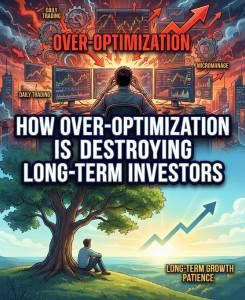
The Cult of the Decimal Point
The investors with the most “optimized” portfolios often perform the worst. They have the smartest strategies. They have the lowest theoretical tax bills. So, they have the most diversified factor exposures. And they lose. Why? Because they suffer from complexity fragility.
They build a machine so precise that it breaks the moment human behavior enters the equation. They spend so much time looking at the decimal points that they miss the integers. Here is how the pursuit of the “perfect portfolio” is killing the “good enough” portfolio and why simplicity is the only true alpha left.
The Direct Indexing Trap (The “Hotel California” Problem)
In 2024 and 2025, “direct indexing” became the hottest trend for high-net-worth investors. The pitch was seductive: Instead of buying the S&P 500 ETF (one ticker: SPY), you buy all 500 individual stocks. Why? So you can sell the losers. If the index is up 10%, but Tesla is down 20%, you sell Tesla to “harvest” the loss. You use that loss to offset your taxes. It sounds like free money. The algorithm does it automatically.
Example: The Locked-In Millionaire:
I consulted with a client, “Robert.” He had $2 million in a direct indexing program managed by a robo-advisor. He wanted to fire the advisor and move to a simpler strategy. He wanted to buy a house and needed liquidity.
Yes, he couldn’t. He didn’t own one fund. He owned 480 distinct slivers of stocks. To move his portfolio, he had to transfer 480 positions. To sell for the house, he had to execute 480 trades. Worse, his “cost basis” was a mess. Because he had been “harvesting losses” for five years, his remaining portfolio was almost entirely gains. If he sold anything to simplify, he would trigger a massive tax bill.
He was trapped. He had saved maybe 0.15% a year in taxes, but he had lost 100% of his flexibility. So he couldn’t leave. He was in a financial hotel in California.
The Lesson:
Optimization creates complexity. Complexity creates friction. Friction kills liquidity. A simple ETF you can sell in one second is worth more than a complex basket you are married to forever.
The Factor Investing Fatigue (The Behavioral Gap)
Academics love “factors.” They have proven, historically, that small-cap value stocks beat large-cap growth stocks over long periods. The math is irrefutable. So, the optimizer says, “Tilt the portfolio 20% to small-cap value.” For a deep study about momentum factor investing, check this.
Example: The Value Crusader
Michael read all the white papers. In 2014, he optimized his portfolio. He underestimated the S&P 500 and overestimated small-cap value. He was optimizing for the “Value Premium.”
Then the next decade happened. From 2014 to 2024, Large-Cap Tech (Growth) absolutely crushed value. Every year, Michael looked at his statement. His “optimized” portfolio was lagging the “dumb” S&P 500 by 5% or 6%. He held on for three years. Five years. Seven years. By year eight, the psychological pain was too much. He felt like an idiot.
His neighbors were getting rich on Nvidia; he was losing money on regional banks. In 2023, he capitulated. He sold his value stocks and bought tech. He sold at the bottom and bought at the top. The optimization failed not because the math was wrong, but because the human couldn’t endure the variance.
The Lesson:
The best portfolio is not the one with the highest theoretical return. It is the one you can stick with when it is underperforming. A suboptimal strategy you hold for 30 years beats an optimal strategy you abandon after 5.
The Yield Farming Whack-a-Mole (The Opportunity Cost)
In a high-interest rate environment, cash became king. Banks started competing. 4.5%. 4.8%. 5.0%. 5.25%.
Optimizers became “Yield Farmers.” They moved money constantly to chase the intro rate or the slightly higher yield.
Example: flagged the deposit.
The 0.5% Chaser “Sarah” had $50,000 in savings. She saw a new bank offering 5.5% (her current bank paid 5.0%). The difference is $250 a year. Not nothing, but small. She initiated the transfer. The new bank’s fraud algorithm Her money was frozen for 10 days while she faxed (yes, faxed) documents to prove her identity. During those 10 days, the stock market had a massive correction—a perfect buying opportunity. She wanted to deploy the cash into the market. She couldn’t. It was in limbo.
She missed a 4% market rally to gain an extra 0.5% in interest. She stepped over dollars to pick up pennies. The Lesson: Friction has a cost. The time and mental bandwidth you spend chasing marginal yield is better spent on earning more income or just enjoying your life. The stress of “admin” is a negative return on your happiness.
The Tax Tail Wagging the Dog
We are taught to hate taxes. We will do anything to avoid them. Optimizers often make investment decisions solely based on tax impact, ignoring the investment merit.
The Real Example: The Legacy Hold
James inherited stock in a dying retail company. It was worth $100,000. His cost basis was low. If he sold, he would owe $15,000 in taxes. He hated the company. He knew retail was dying. But he couldn’t stomach writing a check to the IRS. “I’ll wait until my income is lower to sell,” he said. He was optimizing for the tax bracket. Two years later, the company announced bankruptcy. The stock dropped 90%. His
$100,000 became $10,000. He saved $15,000 in taxes. He lost $75,000 in principal.
The Lesson:
Taxes are a fee on profit. If you are paying taxes, you made money. Never let the fear of a 20% tax bill cause you to lose 100% of the asset. It is better to pay the tax and redeploy the capital into something that will grow, rather than holding a sinking ship just to spite the IRS.
The Rebalancing Overkill
Rebalancing (selling high, buying low) is good. But “continuous rebalancing” is a trap. Some robo-advisors rebalance every day. If an asset drifts 0.1% off target, they trade. This generates thousands of tax lots. It generates “wash sale” complications.
The Real Example: The Accountant’s Nightmare
Elena used an aggressive algorithmic trader. At tax time, her 1099-B was 400 pages long. She had thousands of small trades. Her accountant charged her an extra $1,000 just to process the return because of the complexity of the wash sales and cost basis adjustments. The “optimization” gained her maybe $300 in theoretical alpha. The accountant cost her $1,000. She lost money by being too smart.
The Lesson:
Rebalance annually. Or when the drift is huge (like 5%). Doing it daily is just churning. It creates paperwork, not wealth.
The Case for “Roughly Right
The antidote to over-optimization is robustness. A robust portfolio is simple. It has few moving parts. It is resilient. “Right,” rather than “Precisely Wrong.”
The Robust Portfolio:
- Total Market Index Fund:
You own everything. You don’t bet on sectors. So you don’t bet on factors. - One or Two Banks:
You don’t chase yield. You value the relationship and the ease of access. - Accepting Taxes:
You sell when the investment thesis is broken, regardless of the tax bill. - Liquidity:
You value the ability to get your money out in 24 hours more than you value an extra 0.1% return.
The Mental Bandwidth Dividend
There is a final, invisible benefit to stopping the optimization game. Peace. The optimizer is always anxious. They are always checking. “Did rates go up?” “Is ‘small-cap value’ back?” “Did I harvest that loss?”
They are running a hedge fund in their spare time. And they are usually doing a bad job of it. The robust investor is bored. That’s why they own the market. They save money. They wait. Ironically, this often leads to higher wealth. Because they get promoted.
They don’t make panic decisions. They stay the course.
Conclusion: Be Less Smart
In 2026, the tools to optimize are everywhere. AI agents will promise to manage your money to the nanosecond. Resist them. Wealth is not found in the nanoseconds. It is found in the decades. So it is not found in the complexity. It is found in the simplicity.
Don’t be the genius who creates a tax-efficient, factor-tilted, direct-indexed prison for yourself. Be the “dummy” who buys the index, ignores the noise, and ends up rich. The goal is not to have the perfect portfolio. The goal is to have a portfolio that survives you.
Disclaimer
Look, Admin has been doing this a long time, but I’m a strategist, not your specific financial advisor or lawyer. The markets and regulations mentioned here, like the FinCEN rules or tariff situations, change faster than the weather. This article is meant to make you think strategically, not to replace professional advice tailored to your exact situation. Always do your own due diligence and consult with qualified professionals before making major moves.