In twenty-five years of advising on wealth, I have seen a specific tragedy play out dozens of times.
A client comes in. They are smart. Absolutely, they are diligent. They show me their spreadsheet. It says, “Emergency Fund: $50,000.” They feel safe. They sleep well.
Then the crisis hits. A recession. A layoff. A medical emergency. And suddenly, that $50,000 isn’t there. Or it’s worth $30,000. Or it’s locked behind a penalty wall. The client is shocked. “I did everything right,” they say. “I saved the money.”
The Illusion of Safety
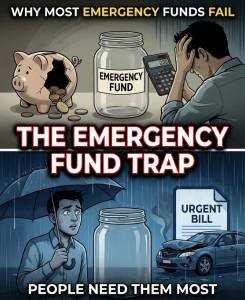
But they didn’t. They saved the wrong money in the wrong place at the wrong time. Most emergency funds fail not because the saver was lazy but because they misunderstood the nature of a modern financial crisis. They built a wall made of paper, thinking it was stone. Here is why your safety net might actually be a trap, illustrated by the real (anonymized) disasters I have witnessed.
The “Market-Linked” Gamble (The Correlation Failure)
This is the most common failure mode in 2026. People hate cash. Cash is boring. Cash loses value to inflation. So, smart people try to be “efficient.” They put their emergency fund in a “conservative” brokerage account. Maybe a low-volatility ETF. Maybe a dividend stock portfolio. They think, “I’ll earn 7% instead of 4%.” “If I need it, I’ll sell.”
The Real Example: The Tech Wreck
I knew a senior engineer at a major tech firm. Let’s call him David. David had $100,000 in “liquid investments” as his safety net. It was mostly in a tech sector ETF because “tech is the future.” Then 2022 happened. Tech stocks crashed 30%. Simultaneously, his company announced layoffs. David lost his job. This is correlation risk.
This is correlation risk.
The event that caused him to need the money (the recession) was the exact same event that destroyed the value of the money. He had to sell his $100,000 fund for $70,000. He crystallized a $30,000 loss just to
pay his mortgage.
The Lesson:
An emergency fund must have zero correlation to the stock market or your industry. If the market crashes, your fund must stay flat. If it drops even 1%, it is not an emergency fund. It is an investment.
The HELOC Trap (The Credit Freeze)
Real estate investors love this one. They use a home equity line of credit (HELOC) as their emergency fund. “I have $200,000 in equity,” they say. “I can draw on it anytime. Why let cash sit idle?” It sounds brilliant. It is mathematically optimal. Until the bank panics.
The Real Example: The 2008 Freeze
During the Great Financial Crisis, banks were terrified. They looked at their balance sheets and saw too much risk. Overnight, millions of homeowners received letters. “Your HELOC limit has been reduced to your current balance.” For more study about the financial crisis in 2008, you can check.
Or worse, “Your line has been frozen.” “I had a client, ‘Sarah,’ who ran a small business. She relied on her HELOC to cover payroll during slow months. In 2008, sales dried up. She went to draw on the line. Frozen.
She had the equity. She owned the house. But the bank controlled the liquidity. She nearly went bankrupt because she relied on a line of credit that evaporated exactly when the economy turned sour.
The Lesson:
A line of credit is not cash. It is permission. Permission can be revoked. An emergency fund must be money you own, not money you are allowed to borrow.
The “Lifestyle Creep” Leak
This failure is behavioral, not structural. Most people define “emergency” too loosely. The transmission blows? Emergency. The roof leaks? Emergency. The cousin’s destination wedding? Well… it’s a “once in a lifetime” event… Emergency? If you dip into the fund for non-catastrophic events, you erode the buffer.
The Real Example: The Renovator
Mike had $30,000 saved. A solid 6-month buffer. Then he decided the kitchen looked dated. “I’ll use $15,000 from the fund and pay it back over the next year,” he told himself. He treated his emergency fund like a 0% interest loan to himself. Three months later, his wife needed surgery. The out-of-pocket max was $10,000. Then the water heater died. $2,000.
Suddenly, the fund was empty. Mike had to put the rest on a credit card at 24% interest. The kitchen renovation ended up costing him thousands in interest because he had drained the liquidity required for real life. You need two funds.
The Lesson:
The Sinking Fund: For car repairs, house maintenance, and anticipated expenses. The Bunker: For job loss, death, or total disaster. You never touch the bunker for a broken window. You touch it when the world ends.
The Inflation Illusion (The Silent Killer)
This is the opposite of the “market gamble.” This is playing it too safe. People leave $50,000 in a standard checking account earning 0.01%. They ignore inflation.
The Real Example: The Retiree
Eleanor retired in 2010. She kept $100,000 in cash for emergencies.
By 2022, inflation had spiked. The cost of healthcare, food, and energy soared.
That $100,000 was still $100,000 on paper. But in terms of purchasing power—what
It could actually buy—it was worth closer to $70,000.
She had lost 30% of her safety net without ever spending a dime.
The Lesson
An emergency fund must tread water. It cannot sit in a checking account. It must be in a high-yield savings account (HYSA) or treasury bills. These instruments are risk-free (FDIC or government-backed), but they pay interest that roughly tracks inflation. If you aren’t earning at least 4-5% on your cash in 2026, you are voluntarily paying a tax on your safety.
The COBRA Shock (The Calculation Error)
How much do you need? “Three to six months of expenses.” That is the standard advice. But how do you calculate “expenses”? Most people look at their current checking account outflow. Mortgage, food, Netflix, gas.
They forget the one massive expense that their employer currently pays: health insurance.
The Real Example: The Family of Four
Tom was laid off. He had calculated his monthly burn rate at $6,000. He had
$36,000 saved (6 months). Then he got the COBRA letter.
To keep his family’s health insurance, the premium was $2,400 a month.
His burn rate wasn’t $6,000. It was $8,400. His 6-month fund was actually a 4-month fund.
He ran out of money two months before he found a new job. He had to raid his
401(k), pay the penalty, and pay the tax.
The Lesson:
When calculating your emergency number, you must add the full cost of unsubsidized health insurance. In the US, this is often the single largest shock for the unemployed.
The Illiquidity Trap (I-Bonds and CDs)
We are told to lock money away to get higher rates. I-Bonds were great in 2022. CDs offer 5%. But they have “lock-up periods.” You cannot touch I-Bond money for 12 months. CDs have penalties for early withdrawal—often 3 to 6 months of interest.
The Real Example: The Bond Lover
James put his entire emergency fund into a 5-year CD ladder to maximize yield. He needed the money in month 4. To break the CDs, the bank charged a penalty that wiped out all the interest he had earned, plus some principal. Worse, the administrative process took three days. He needed the money that
afternoon for a bail bond (long story). He had to use a predatory payday loan for 48 hours while waiting for his own money to unlock.
The Lesson
“Liquid” means you can access it today. Laddering is fine for Tier 2 savings. But Tier 1 (the first 2 months of expenses) must be instantly accessible. No penalties. No waiting periods.
The “Tiered Defense” Solution
So, how do you build an emergency fund that actually works? You don’t treat it as one pile of money. You treat it as a tiered defense system.
The “Panic Button” (1 Month of Expenses)
- Location: Checking account buffer or local savings.
- Goal: Instant access. 24/7 liquidity.
- Yield: Irrelevant. Even if it earns 0%, its job is availability.
The “Bunker” (2-3 Months of Expenses)
- Location: High-Yield Savings Account (HYSA) separate from your main bank.
- Goal: Inflation protection + psychological barrier.
- Why separate? If it takes 2 days to transfer, you won’t use it for impulse buys. But it is there within 48 hours for a job loss.
The “Deep Reserve” (3-6 Months of Expenses)
Location: Rolling 4-Week T-Bills or a No-Penalty CD.
Goal: Maximum risk-free yield. State tax exemption (T-bills).
Function: This is the money you tap if the recession drags on. It earns a real return while it waits.
The Psychological Component
The final reason funds fail is shame. People feel guilty about having “lazy money.” They feel like they are missing out on the bull market. You have to reframe this. Your emergency fund is not an investment. It is not supposed to make you rich. It is an insurance premium you pay to yourself.
Its “return on investment” is that it prevents you from selling your actual investments (stocks/crypto) at the bottom. If your emergency fund allows you to hold your S&P 500 index fund through a 40%
crash without selling a single share, then that cash has generated a massive return.
Summary: The Anti-Fragile Fund
To survive 2026, your fund must pass this audit:
- Is it correlated? If the market tanks, is the money safe?
- Is it yours? Are you relying on a bank’s permission (HELOC)?
- Is it real? Have you accounted for inflation and COBRA?
- Is it segregated? Is it separate from your vacation fund?
If you can answer yes to all four, you don’t just have savings. You have survival.
Disclaimer
Look, Admin has been doing this a long time, but I’m a strategist, not your specific financial advisor or lawyer. The markets and regulations mentioned here, like the FinCEN rules or tariff situations, change faster than the weather. This article is meant to make you think strategically, not to replace professional advice tailored to your exact situation. Always do your own due diligence and consult with qualified professionals before making major moves.