In this blog, we are going to discuss the silent decay of assets, specifically focusing on how inflation, hidden fees, structural flaws, and pure neglect destroy wealth far more effectively than any sudden market crash. We will break down exactly how this erosion happens under the radar and what you must do to stop it.
Turn on any financial news network today. You will see flashing red tickers. You will hear analysts screaming about the next massive market correction. They want you terrified of the sudden, loud explosion that might wipe out twenty percent of your portfolio overnight.
The Invisible Enemy
Meanwhile, your wealth is likely bleeding out through a thousand tiny cuts. In twenty-five years of market strategy, I have rarely seen a client permanently ruined by a bear market. Markets crash, and then they
recover. That is the natural breathing cycle of the economy.
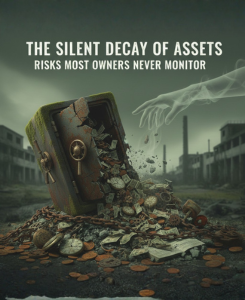
However, I have seen hundreds of millionaires slowly reduced to financial anxiety. They did not lose their money in a single bad trade. Instead, their wealth evaporated quietly. It happened while they were sleeping. It happened while they were playing golf.
We call this Silent Asset Decay.
It is the carbon monoxide of personal finance. It has no smell. Yes, it makes no sound. By the time you realize you are suffocating, the damage is already permanent. Most asset owners only monitor the top-line number on their brokerage statement. If that number stays flat, they feel safe. They are incredibly wrong. A static number is actually a dying asset. Let’s examine the five specific ways your assets are silently rotting away right now.
The Purchasing Power Hemorrhage (Inflation Decay)
The most dangerous lie in finance is the concept of “nominal value.” Nominal value is the number printed on your statement. If you have one million dollars in a high-yield savings account earning four percent, you assume you are making money. Your statement shows your balance growing. Consequently, you feel financially secure. You must look at the “real value.” Real value factors in the cost of remaining alive in the actual world.
Consider a real-world scenario. “Richard” sold a mid-sized logistics business in 2018 for three million dollars. He was terrified of the stock market. Therefore, he placed the entire sum into municipal bonds and cash equivalents. He wanted absolute safety. He locked in a yield of roughly three percent. Every year, his accounts generated ninety thousand dollars. He lived on that income.
Then, the post-2020 inflationary wave hit. The cost of property taxes, insurance, food, and healthcare surged. Officially, inflation touched eight percent before settling down to around four percent by 2026.
Richard’s three million dollars never dropped in nominal value. However, the purchasing power of that money collapsed. To buy the exact same lifestyle in 2026 that he enjoyed in 2018, he needed nearly a hundred and thirty thousand dollars a year. His portfolio still only produced ninety.
Foundation and inflation
Essentially, Richard lost thirty percent of his wealth. He never saw a red day in the market. He never took a bad risk. Simply, he allowed inflation to eat his foundation. Cash is not a risk-free asset. It is a guaranteed loss of purchasing power over a long enough timeline. Holding too much cash is the fastest way to guarantee silent decay.
The Friction Factor (Fee Decay)
Wall Street does not steal your money. They simply charge a toll on your money every single day until it becomes their money. Many investors believe they only pay a simple one percent “Assets Under Management” (AUM) fee to their friendly financial advisor. They consider this a fair price for a yearly lunch and a nice binder full of charts. Unfortunately, that one percent is usually just the tip of the iceberg.
Beneath the surface, the decay accelerates.
We call this the Friction Factor.
Many investors believe they only pay a simple one percent “Assets Under Management” (AUM) fee to their friendly financial advisor. They consider this a fair price for a yearly lunch and a nice binder full of charts. Unfortunately, that one percent is usually just the tip of the iceberg. Beneath the surface, the decay accelerates. Your advisor likely places your money into mutual funds or ETFs. These funds charge their own internal fees, known as expense ratios.
Sometimes, these funds charge 12b-1 fees just for marketing themselves. Furthermore, the platform holding your money might charge custody fees. Suddenly, your total fee burden is not one percent. It is closer to two
percent.
Let us do the brutal math on fee decay. If the market returns seven percent, and your total fee drag is two percent, you are only keeping five percent. You might think, “I still made five percent; that is fine.” You are entirely missing the scale of the theft. You took one hundred percent of the risk. You provided one hundred percent of the capital. Yet, the financial industry just took nearly thirty percent of your profit.
Let’s take a scenario.
Over a thirty-year investing timeline, a two percent fee drag will consume almost forty percent of your potential total wealth. I recently audited a portfolio for “Sarah,” a successful architect. She had a “guy” managing her money for fifteen years. We calculated her total friction. She was paying twenty-two thousand dollars a year in hidden fees for a portfolio that essentially just tracked the S&P 500.
She was experiencing massive structural decay. We moved her to low-cost index funds. We instantly stopped the bleeding. Check your expense ratios today.
Structural Rot (Tax and Legal Decay)
An asset is only as strong as the container holding it. If you put water in a paper bag, you will eventually lose the water. Many people own fantastic assets inside terrible legal and tax structures. This creates a continuous, silent leak. Tax decay happens when you hold the wrong asset in the wrong account. For example, bonds generate interest. The IRS taxes interest at your highest ordinary income rate.
If you hold a corporate bond fund in your standard taxable brokerage account, you are handing a massive chunk of your yield straight to the government every year. Conversely, if you place those same bonds inside a tax-sheltered IRA, you stop the decay instantly. You keep the entire yield.
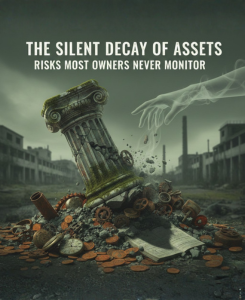
Legal decay is even more terrifying.
Consider “Marcus.” He bought three rental properties over ten years. He cash flowed beautifully. However, he kept all three properties in his own personal name to save the minor hassle of filing LLC paperwork. A contractor slipped on an icy driveway at property number two. The contractor sued.
Because the asset lacked a proper legal container, the lawsuit did not just target the single property. It targeted Marcus personally. It targeted his primary residence. So, it targeted his brokerage accounts. His wealth did not decay because the real estate market crashed. It decayed because his legal architecture was made of straw.
If you own significant assets, you must build proper containers. Use LLCs for real estate. Use trusts for estate planning. And use tax-advantaged accounts for high-yield assets. Stop letting your wealth leak out through the floorboards.
The Maintenance Deficit (Physical and Operational Decay)
This specific decay mostly targets real estate and business owners. If you own a physical asset, it is constantly returning to the earth. Entropy is a law of physics. Paint peels. Roofs leak. Software becomes obsolete. Many landlords boast about their incredible cash flow. They show me spreadsheets proving they make a twenty percent return on their rental properties.
When I dig deeper, I find the illusion. They achieve that cash flow by spending absolutely zero dollars on capital expenditures (CapEx). They have not replaced a carpet in ten years. And they have not updated an
appliance since the Obama administration.
Liquidating the physical value
They are not generating brilliant cash flow. They are simply liquidating the physical value of the property and calling it income. Eventually, the market notices the decay. Quality tenants leave. Rents drop.
Suddenly, the owner faces a massive fifty-thousand-dollar renovation bill just to make the property habitable again. The “profits” they bragged about for five years vanish in one weekend.
The same applies to small businesses. If you own a company and you stop investing in new marketing, new talent, or updated technology, your business is decaying. Your revenue might stay flat for a year or two through sheer momentum. Eventually, a hungrier competitor will take your market share.
You must reinvest a portion of your yield back into the asset. If you do not feed the machine, the machine will starve.
The Opportunity Cost Bleed (Lazy Equity)
This is the most controversial form of decay. People hate hearing about it because it attacks their sense of safety. Having a paid-off house is the American Dream. It feels incredibly safe to owe the bank nothing.
However, from a purely strategic standpoint, massive amounts of dead equity represent severe asset decay through opportunity cost. Let us look at “Elena.” She is sixty years old. She owns a one-point-five-million-dollar home free and clear. She loves telling people she is a millionaire.
Yet, Elena struggles to pay her property taxes. She drives a fifteen-year-old car. So, she clips coupons. She has a million and a half dollars trapped in drywall and wood. That equity produces zero cash flow. In fact, it costs her money in taxes and maintenance. If Elena tapped half of that equity and deployed it into a conservative portfolio yielding five percent, she would generate nearly forty thousand dollars a year in passive income. She could fix her car. She could travel.
Equity that sits idle is lazy. In a world where risk-free Treasury bills pay solid yields, leaving millions of dollars trapped in an unproductive asset is a silent, massive loss of potential income. You must measure your “Return on Equity.” If the return is zero, the asset is decaying relative to its potential.
The Behavioral Tax (The Friction of Inaction)
We often discuss the dangers of trading too much. We warn people about panicking and selling during a crash. However, the exact opposite behavior is equally destructive. Total paralysis causes severe asset decay. The financial world changes constantly. The tax code shifts. Interest rates rise and fall. Sector dominance transitions from energy to tech to AI. If you build a portfolio in 2016 and refuse to look at it for ten years because you believe in “set and forget,” you are bleeding. Setting and forgetting is a strategy for cooking a pot roast. It is a terrible strategy for managing a family legacy.
For instance, the tax cuts enacted years ago are scheduled to sunset. Estate tax exemptions are moving targets. If you do not actively adjust your strategy to meet the new reality, you will pay a massive “Behavioral Tax.” Your inaction becomes your biggest liability. Your assets require periodic audits. They require pruning. They require active direction.
The Asset Audit Protocol
You cannot fix a leak you refuse to look for. You must stop staring at the daily stock ticker and start examining the structural integrity of your wealth.
Personal inflation rate and growth
First, calculate your true friction. Find every single expense ratio, management fee, and hidden platform charge in your portfolio. If the total number exceeds one percent, you must restructure immediately.
Second, evaluate your real return. Subtract your personal inflation rate and your tax burden from your total yield. If that final number is negative, you are actively losing purchasing power. You must deploy your lazy cash.
Wealth is a living organism. It does not exist in a vacuum. It is constantly attacked by the environment around it. You cannot simply build it and walk away. You must defend and maintain it. If you ignore the silent decay, you will eventually wake up to a hollow foundation. Stop watching the noise on the television. Start watching the termites in your basement.
Disclaimer
This article is for financial awareness and money management education only. It does not provide investment, legal, or tax advice, and does not recommend any financial products. You should always conduct your own research and consult with qualified professionals before making any structural changes to your financial or legal affairs. Markets, tax codes, and regulations are subject to constant change, and strategies discussed may not be suitable for your specific personal circumstances.
Contact us for more information.