Entrepreneurs ask this question when they start anew. They ask the question. “So, which one of LLC and Sole Trader is more cost-effective to set up than the other? After studying and doing research, I can say that in twenty-five years of building and scaling business models, I have never seen a company that failed because they spent $300 on registration fees. I have analyzed dozens of businesses that went bankrupt because they tried to save pennies on structure while losing thousands in unexpected taxes and liability claims. In 2025, the calculation changed completely.
In the March 2025 FinCEN Interim Final Rule, the compliance landscape for US domestic businesses shifted overnight. If you are still engaging with the articles from 2024, then you are operating on absolute data. By analyzing the records and reports from 2023-2024. I have analyzed the shift of our structure and the logic and math behind the decision that affected this change. Let’s break down this shift.
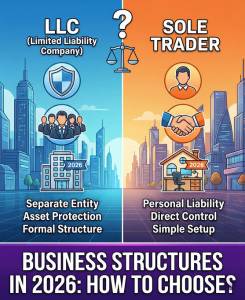
The Sole Trader Trap: (Simple has now become risky)
In business, when you operate as a sole trader or simply a sole proprietor, you and the business are the same entity.
- The Pro:
You don’t file a separate tax return. You take the money, you spend the money—easy. - The Con:
If one’s business gets sued by any individual, you get sued. If your business owes money, you will lose your personal house.
The sole trader model is driven by hobbyists or any individuals who can manage. If this business goes bankrupt. Surely he will manage, if he can. It’s not made for serious brand owners. In 2025, as digital transactions became increasingly popular, the audit risk for sole traders is statistically higher. Tax authorities often inspect commingled personal and business funds with suspicion.
An LLC provides a clean separation that banks and auditors respect. The policy should be designed in a way that allows an individual to start as a sole trader. He can manage the policy regarding his taxes and liabilities.
The FinCEN Interim Rule: The game changer in 2025.
A couple of years ago, the main argument against forming an LLC was terror of the Corporate Transparency Act and its strict reporting requirements. The general market is not aware of something like this. FinCEN issued an interim final rule that significantly altered the playing field. This rule has removed the beneficial ownership information (BOI) reporting requirement for many domestic entities.
Shifting the focus largely to foreign entities registered in the US. However, there are some reports claiming that the policymaker is looking forward to depending on the local entities of the US. Policy-changing rumors only, but no step is taken anyway for this. So we might not be sure in what way the policy will go. So that individual business entity can benefit from that. And somehow, why this matters,
- The “red tape” excuse is dead. The administrative nightmare that scared business owners in 2025 has been a lower-friction time to formalize your business than right now.
The S-Corp ‘Sweet Pot,” The Tax Math
In the business world, we did not just choose an LLC for protection; we chose it for tax agility. An LLC is a chameleon.
- By default, LLCs are taxed like sole traders. You get the simplicity.
- The upgrade: Once your net profit hits the $60,000 to $70,000 range.
You can be elected to be taxed as an S-Corp. This election allows you to split your income into two buckets.
- Salary W-2: Subject to a 15.3% self-employment tax.
- Distributions: Exempt from Self-Employment Tax.
The calculation will be in this way: if you make $100,000 as a sole trader, you pay self-employment tax on the full $100,000. As an S-corp, you might pay yourself a $60,000 salary and take $40,000 as distributions. You just legally saved the 15.3% tax on that $40,000. That is roughly $6,000 in pure savings just by having the right piece of paper.
Decision Framework:
| If your business is | Recommended | Why do you want to switch |
|---|---|---|
| Side Hustle (<$30k/yr) | Sole trader | The admin cost of an LLC outweighs the tax benefits. |
| Full-time (>$45k/yr) | LLC | The liability shield becomes necessary. |
| High Growth (<$80k/yr) | LLC (w/S-Corp Election) | The tax savings now pay for the accounting costs. |
| Selling Physical Product | LLC (Immediately) | Product liability risk is too high to ignore |
Why is an LLC one step up from a sole trader
International Institutions and Financial Reports, LLC, is more effective than a sole trader due to risk and other options like better tax options. You have choices in every range of outcomes. You can visit the U.S. Internal Revenue Service for more details on LLCs.
Choices:
Here is the part no one talks about loudly: an LLC permits you to dream bigger in this era. Sole proprietorships often stake less because they are extensions of the owner. If you burn out or life changes, the business fades. But an LLC? It is built to outlive you. It can bring in partners and sell shares of ownership. Or even continue after you are gone with the right operating agreement.
Final Driven Thought
We did not structure our business as an LLC to look big. We did it because in 2025, efficiency is not about how much you make. It is about how much you keep. Don’t build a skyscraper on a sand foundation. Structure it right, and the market will respect you.
Disclaimer:
Admin is noneither market strategist nor a CPA. Regulations, including the March 2025 FinCEN Interim Rule, are subject to change and court challenges. This article is for informational purposes only and does not constitute legal or financial advice. Always consult with a certified tax professional before making structural changes.
This is a very well-written and informative blog. The information is clearly explained and easy to understand. I found it extremely useful and learned a lot from it. Great effort—keep sharing such valuable content!