If you look at a financial plan in a textbook, it is a straight line. It starts at the bottom left (zero dollars) and goes to the top right (millions of dollars). It looks smooth. It looks predictable. Real life does not look like that.
Real life is a series of distinct seasons. The money strategies that work when you are 25 are dangerous when you are 65. The risks that keep you up at night when you have a newborn are irrelevant when you are an empty nester.
In twenty-five years of advising, I have learned that successful wealth building isn’t about finding one perfect strategy. It is about adapting your strategy to the weather you are currently in.
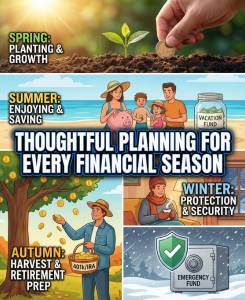
Financial Season
Spring: The Season of Planting (Ages 20-30)
This is the hardest season. I don’t care what the older generations say about “avocado toast.” Being young in this economy is brutal. In spring, you have the most powerful asset: time. But you have the scarcest resource: capital. You are “cash poor” but “future rich.”
The Core Challenge: The Gap
Your goal in spring is not to get rich. It is to survive without digging a hole. Student loans are dragging you down. Entry-level wages are low. Rent is high. The mistake I see here is trying to “invest” before you have “saved.” I see 24-year-olds buying crypto when they don’t have $1,000 for a car repair. That is not planting; that is gambling.
The Strategy:
- Aggressive Defense:
You must defend the gap between income and expense. If you spend everything you make now, you establish a baseline lifestyle that will be impossible to break later. - The Roth IRA:
This is the magic seed. Putting money into a Roth IRA when your tax bracket is low (because you are young and broke) is the smartest tax move you will ever make. You pay the tax now (on little money) so you never pay it later (on huge growth). - Skill Acquisition:
Your best investment isn’t the S&P 500. It is you. Spending $2,000 on a certification that raises your salary by $10,000 is a 500% return. Wall Street cannot beat that.
The Trap:
Credit card debt. In spring, debt feels like a lifeline. It is actually a chain. If you enter summer with consumer debt, you are starting the race with a broken leg.
Summer: The Season of Growth (Ages 30-50)
Welcome to the “Messy Middle.” This is the most expensive season of your life. It is chaotic. It is loud.
You are likely earning more money than ever before. But you feel poorer than ever before. Why? Because life got expensive. Mortgages. Daycare (which costs as much as a mortgage). Weddings. Diapers.
The Core Challenge: The Squeeze
In summer, you are being squeezed from both sides. You have to save for your future (retirement) while paying for your present (kids/house). The stress here is palpable. I sit across from couples making $250,000 who feel like they are drowning.
The Strategy:
- Automated Offense:
You cannot rely on willpower in summer. You are too tired. So, you must automate your savings. If the money hits your checking account, it will get spent on soccer cleats. It must leave your paycheck before you see it. - Insurance is Love:
This sounds cheesy, but it is true. In spring, if you died, it was a tragedy but not a financial catastrophe. In summer, people rely on your income. If you don’t have term life insurance (10x your income), you are driving a car without brakes. - The 529 Balance:
Do not sacrifice your retirement for your kids’ college. You can borrow for college. You cannot borrow for retirement. Put on your own oxygen mask first.
The Trap:
Lifestyle Creep. This is the season where the “Joneses” show up. You see the neighbor’s new SUV. You see the vacation photos on Instagram. If you upgrade your lifestyle every time you get a raise, you are running on a treadmill. You are moving fast but going nowhere.
Autumn: The Season of Harvest (Ages 50-65)
One day, you wake up, and the house is quiet. The kids are gone (or at least, they are cheaper). The mortgage might be paid off. Welcome to Autumn. This is the “Catch Up” season. For many, this is the first time in decades they have actual free cash flow.
The Core Challenge: The Shift
The danger in autumn is complacency. You see the retirement finish line, and you want to coast. But this is actually your highest-leverage decade. Your earnings are likely at their peak. Your expenses have dropped. This creates a massive “super gap.”
The Strategy: Maximum Extraction:
You need to shovel money into tax-advantaged accounts. Catch-up contributions to 401(k)s and IRAs are allowed now. Use them.
Risk Calibration:
In spring, a market crash was a buying opportunity. In autumn, it is a threat. You don’t have 30 years to recover anymore. You need to start dialing down the risk. Not to zero, but away from “aggressive growth.”
toward “balanced growth.” Your biggest financial risk is no longer the stock market. It is your body. Healthcare costs in retirement will be massive. Investing in your health now—gym, diet, preventative care—is a direct financial strategy.
The Trap:
The “Gray Divorce” or the “Second Childhood.” I see people get to 55, feel flush with cash, and buy a boat they can’t afford. Or they panic about their youth fading and make reckless personal decisions that
split their assets in half. Stay the course. The harvest isn’t in the barn yet.
Winter: The Season of Distribution (Ages 65+)
Whatever you call it, Winter is fundamentally different. For 40 years, you have been a “saver.” You have been an “Accumulator.” Psychologically, you are wired to hoard. Now, you have to do the unnatural thing: You have to become a “spender.”
The Core Challenge: Decumulation
Turning a pile of money into a paycheck is harder than saving the pile was. You face “Sequence of Returns Risk.” If the market crashes the year you retire, and you keep withdrawing money, you can deplete the portfolio too fast.
The Strategy: The Bucket System:
You don’t keep all your money in the market. You keep 2-3 years of living expenses in cash (Bucket 1). You keep 5-7 years in bonds (Bucket 2). You keep the rest in stocks (Bucket 3). When the market crashes, you spend from Bucket 1. You don’t sell the stocks. You wait for them to recover. This buys you peace of mind. Which account do you pull from? Traditional IRA? Roth? Taxable? The order matters. Getting this wrong can trigger massive tax bills and higher Medicare premiums. You need a withdrawal strategy, not just a withdrawal rate.
The Permission to Spend:
- This is the hardest part. I have to beg clients to
- Take the trip. They are terrified of running out of money. But dying with the biggest bank account isn’t the goal. The goal is utility.
- If you have “over-saved,” you need to start giving with a warm hand, not a cold one. Help your grandkids now, when they are in their Spring, rather
- than leaving them a lump sum when they are already in their autumn.
The Trap:
Inflation eats your purchasing power silently. You still need some growth assets (stocks) in winter to fight this. You cannot go 100% into CDs. Isolation is the other risk. The best investment in Winter is community. It costs nothing but pays the highest dividend in happiness. For a deep study about stages and planning financial growth, you can check this.
Conclusion: Respect the Cycle
You cannot force the harvest in spring. You cannot plant seeds in winter. Financial stress often comes from trying to be in a season you aren’t in. The 25-year-old stressing about retirement distribution strategies is wasting energy. The 50-year-old trying to take the risks of a 20-year-old is courting disaster.
Look at your life. Check the weather. Are you planting? Growing? Harvesting? Or distributing? Adjust your plan to the season. Respect the cycle.
Disclaimer
Look, Admin has been doing this a long time, but I’m a strategist, not your specific financial advisor or lawyer. The markets and regulations mentioned here, like the FinCEN rules or tariff situations, change faster than the weather. This article is meant to make you think strategically, not to replace professional advice tailored to your exact situation. Always do your own due diligence and consult with qualified professionals before making major moves.