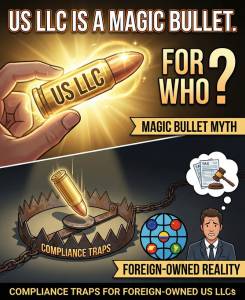
The internet sells a dangerous myth about American business. It says a “US LLC” is a magic bullet. Zero tax. Total anonymity. Set up in 24 hours. For European, Asian, and Latin American investors, this pitch is seductive. You can sit in Berlin or Buenos Aires, click a button, and own a Delaware company. But in 2026, the reality is starkly different. While US domestic owners recently saw massive regulatory relief, foreign owners were left in the crosshairs. Washington has tightened the net on cross-border capital. They are using new tools to see exactly who owns what.
And they are using old tools with massive new penalties to punish those who don’t report. The “Wild West” era of the anonymous US shell company is over.
How is it still anonymous?
Most blogs only cover the basics of “how to file.” They ignore the structural traps that can wipe out a portfolio. Here is the data-driven reality of what actually threatens foreign-owned US LLCs this year. The Corporate Transparency Act (CTA) was supposed to unmask everyone. Then, the rules changed in a way that shocked the industry. In March 2025, FinCEN released an Interim Final Rule that effectively exempted domestic US companies from Beneficial Ownership Information (BOI) reporting.
The government decided that tracking every local bakery and consultant was too burdensome. But they kept the mandate for “foreign reporting companies.” This created a two-tier privacy system.
The Trap
A US citizen starting an LLC in Wyoming now has more privacy than you do. If your entity was formed under foreign law but registered to do business in the US, you are the primary target. You must disclose specific details about every beneficial owner.
Substantial Control
The “Substantial Control” Loophole: It is not just about who owns 25% of the shares. The law demands the identity of anyone who exercises “substantial control.” If you have a foreign manager in Dubai who makes decisions for your US LLC, their passport must be uploaded to the US Treasury.
The Consequence
Willful failure to file carries civil penalties of $591 per day. Criminal penalties hit up to $10,000 and two years in prison. The “privacy” you thought you bought with a US LLC is gone for foreign entities. Furthermore, foreign entities registered before March 26, 2025, faced an April deadline to report.
If you missed that window, you are already accruing daily fines.
The $25,000 “Empty Return” Penalty
This is the most common financial fatality I see. Foreign owners often use a single-member LLC. They treat it as a “Disregarded Entity” for tax purposes. They assume:
- “No US income = No US tax return.”
- That logic is fatal.
The Form 5472 Reality
If a US LLC is 25% foreign-owned, it must file Form 5472. This applies even if the LLC had zero profit. It applies if money merely moved between the owner and the LLC. These are called “reportable transactions.” It is not just sales. If you transfer $5,000 from your personal account to the LLC to pay for a website, that is a reportable transaction (capital contribution). If the LLC pays for your flight to New York, that is a reportable transaction. Even paying organizational expenses or legal fees counts.
The Fresh Data
The penalty for failing to file this single form is $25,000. It is not a slap on the wrist. It applies per form, per year. If the IRS sends a notice and you miss the 90-day window, another $25,000 is added every 30 days. There is no maximum cap on this penalty. I have seen businesses with $10,000 in revenue wiped out by a $50,000 penalty for two years of missed “empty” returns.
The “Death Tax” Gap (Estate Tax)
This is the risk almost no one discusses until it is too late. It is the difference between building a legacy and building a liability. A US citizen currently enjoys a federal estate tax exemption of roughly $13.99 million in 2025, rising to $15 million in 2026. They can pass that amount to heirs tax-free. A Non-Resident Alien (NRA) gets a radically different deal.
The $60,000 Cliff
Your exemption for US-situs assets is only $60,000. “US-situs assets” include shares of a US LLC and US real estate. If you pass away owning a US LLC worth $1 million, the IRS does not care about your citizenship.
They care about the asset’s location (“situs”).
The Math
- LLC Value: $1,000,000.
- Exemption: -$60,000.
- Taxable Amount: $940,000.
- Tax Rate: ~40%.
For more details, check the report of the Internal Revenue Service
The Treaty Trap
Your heirs could owe the IRS nearly $376,000 to inherit your business. Many investors assume a tax treaty will save them. The US has estate tax treaties with countries like Germany, the UK, and Japan. However, claiming these benefits is not automatic. Your heirs must file complex returns to claim the treaty position. If you are from a non-treaty country (like Brazil, China, or India), you have almost no protection against this 40% seizure of wealth.
The “Economic Nexus” Shift
In the past, sales tax was about physical presence. If you didn’t have an office in California, you didn’t pay California tax. That era is over. States now use “economic nexus.” They tax you based on revenue generated from their residents. Historically, states used a “200 transactions” count as a trigger. This meant small sellers were safe. By July 2025, 15 states, including California and Illinois, eliminated this transaction count. They moved to a flat revenue threshold, typically $100,000.
The Implication
This sounds like less paperwork, but it is a trap for high-ticket sellers. Consider a European consultancy that sells software implementation services. If you sell ten packages at $15,000 each to clients in New York, you have hit the nexus. You are now liable for state sales tax registration. You must collect and remit tax, even without stepping foot in the US.
The “Trailing Nexus” Danger
Even if you stop selling in a state, some jurisdictions enforce a “trailing nexus.” You remain liable for taxes for months after your last sale. Ignorance of these state-level laws does not stop the compounding interest on back taxes.
The Banking “De-Risking” Purge
The final trap is operational, not regulatory. You can follow every IRS rule and still fail because you cannot keep a bank account open. US banks are under immense pressure to prevent money laundering. In 2025, they began aggressively “de-risking” foreign-owned accounts. It is no longer enough to show a Certificate of Formation. Banks like Mercury and Relay now demand “proof of business activity.” They want to see:
- Invoices to US-based clients.
- Signed contracts with US vendors.
- A physical US footprint (not just a PO Box).
The Account Closure Risk
We are seeing a wave of sudden account closures. Banks have the right to close accounts without notice. If your LLC is flagged as a “shell company” because it lacks verifiable US commerce, your funds can be frozen. This forces you to fly to the US to retrieve a cashier’s check, disrupting operations for weeks. To survive this, you need more than a generic operating agreement. You need a “bank-ready” package that clearly defines ownership, control, and payment flows. Generic templates from online incorporation services often fail this scrutiny.
Strategic Responses: How to Survive
The era of the “Do It Yourself” US LLC is over for foreign investors. The complexity of the new 2026 rules requires a sophisticated structure.
- The Blocker Corporation
To mitigate the estate tax risk, many investors use a foreign blocker.” “
Instead of owning the US LLC directly, you own a foreign corporation (e.g., in the BVI or Cayman), which owns the US LLC.
Upon death, you transfer shares of the foreign company, not the US asset.
This keeps the transaction outside the US tax net. - The “Taxable” Election
Sometimes, it is smarter not to be a disregarded entity.
Electing to be taxed as a C-corporation can simplify reporting.
It removes the Form 5472 ambiguity in some cases, though it introduces double taxation.
It is a trade-off between compliance cost and tax cost. - The Compliance Calendar
You cannot rely on your memory.
- April 15: Form 5472 deadline (with extension).
- Monthly/Quarterly: State sales tax remittances.
- 30 Days: Time to update BOI reports if ownership changes.
My Review On US LLC
The US remains the best place in the world to do business. It offers deep capital markets, legal protection, and credibility. But the “entry fee” has gone up. The cost is no longer just the $300 filing fee to Delaware. The true cost is the rigorous adherence to a compliance web designed to catch billionaires and terrorists. If you are a legitimate business owner, you are collateral damage in this dragnet.
You must treat compliance as a core business function, not an annual annoyance. The penalties for being wrong are simply too high to ignore.
Disclaimer
Admin is a market strategist. I am not an insurance agent. I am not a financial advisor. Rules change by state. Rules change by industry. Always talk to a licensed pro before you buy anything.