If you walk into a financial advisor’s office with $100,000 in cash, they will look at you like you are burning furniture for heat. “Inflation is eating your wealth!” they will scream. “You are missing out on compound interest!” “You are losing purchasing power every second!” They will show you a chart of the S&P 500 going up and to the right for 100 years. They will make you feel reckless for being safe. Here is the secret they won’t tell you: They are biased.
The Industry’s Lie
The financial industry is built on “Assets Under Management” (AUM). If your money is in a savings account, they cannot charge you a 1% fee on it. If your money is in an ETF they manage, they get paid.
Their advice is mathematically correct over 30 years. It is often disastrous over 3 years.
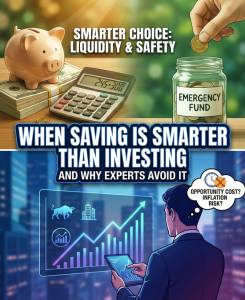
In twenty-five years of strategy, I have seen more people ruined by being “fully invested” at the wrong time than I have seen ruined by holding too much cash. Sometimes, saving is not passive. It is the most aggressive strategic move you can make.
The Short-Horizon Trap (The Down Payment Disaster)
The most common tragedy I see is the “time-horizon mismatch.” Young couples save for a house. They have $50,000. So, they want to buy in two years. They read a blog that says, “Cash is trash.” They put the $50,000 into a “safe” index fund.
The Real Case: The 2022 Homebuyer
Alex and Sarah had saved for five years. They had $80,000 for a down payment. In late 2021, their advisor told them to put it in a “Conservative Growth” portfolio (60% stocks, 40% bonds). “Why let it sit earning 0.5% when you could earn 7%?” the advisor asked. Then 2022 happened. Stocks dropped 20%. Bonds (which are supposed to be safe) dropped 15% because interest rates spiked. Their $80,000 became $66,000. Then, the perfect house came on the market. They couldn’t buy it. They were short on the down payment. That’s why they had to wait two more years to rebuild the capital. By
Then, mortgage rates had doubled. The “opportunity cost” of that investing mistake wasn’t just $14,000. It was the house. It was the 3% mortgage rate they missed.
The Strategy:
If you need the money in less than 3-5 years, it does not belong in the market. The stock market is a wealth-building machine over decades. Over 24 months, it is a casino. Saving is smarter here because principal protection is more valuable than potential return.
The “Dry Powder” Advantage (The Strategic Sniper)
Rich people do not view cash as “savings.” They view it as “dry powder.” Dry powder is ammunition. It sits quietly in the magazine, doing nothing. It earns nothing. Until the target appears. When the economy crashes, assets go on sale. Real estate drops 20%. Businesses sell for 3x earnings instead of 10x earnings. But banks stop lending during crashes. Credit dries up. If you are “fully invested,” you cannot buy these deals. You are likely losing money in your own portfolio, so you feel poor. If you have cash, you are the king.
The Real Example: The 2009 Landlord
In 2008, everyone was panic-selling rental properties. I knew an investor, “Marcus,” who had kept $200,000 in cash. His friends mocked him in 2007 for missing the rally. In 2009, he bought four properties for $50,000 each. Cash. He didn’t need a bank. He didn’t need an appraisal. Those properties are worth $1.5 million today. His “return” on that cash wasn’t the interest rate. It was the optionality. Cash buys you the right to strike when everyone else is retreating. If you are 100% invested, you are a passenger on the market’s rollercoaster. If you have cash, you are the driver waiting for the right turn.
The Psychological Floor (The Return on Sleep)
Finance is not physics. It is psychology. Spreadsheets do not have anxiety. Humans do. There is a concept I call the “Psychological Floor.” This is the amount of liquidity a specific person needs to function normally.
If a person needs $50,000 in the bank to sleep at night, but they invest $40,000 of it, they will be miserable. They will check their portfolio ten times a day. When the market drops 2%, they will panic and sell.
The Real Example: The Anxious Executive
Linda was a high-powered CEO. She earned $400,000. Her advisor told her to keep only $20,000 in cash and invest the rest. Linda was terrified of losing her job. Every time the market dipped, she called
the advisor screaming. She eventually fired the advisor and moved $100,000 to a savings account. Mathematically, she was losing to inflation. Psychologically, she stopped worrying. Her performance at work improved. She got a promotion and a $50,000 raise.
The “Return on Sleep” was higher than the stock market return. If cash buys you the peace of mind to focus on your career (your primary income engine), it is a high-performing asset.
The Deflationary Hedge (When Cash Gains Value)
We are terrified of inflation (prices going up). But we forget about deflation (prices going down). In a severe recession or a debt crisis, cash actually gains value. Why? Because everything else gets cheaper. If a car costs $40,000 today and next year (due to recession) it costs $30,000, your cash just gained 33% in purchasing power without doing anything.
The Real Example: The Tech Bubble Burst
In 2000, tech stocks imploded. Amazon lost 90% of its value. Investors who held cash didn’t just “avoid losses.” They saw their relative wealth skyrocket compared to their peers. They could buy into the best companies in the world for pennies on the dollar. Cash is the only asset that has a correlation of zero to everything else. When stocks, bonds, and real estate all crash together (like in 2022), cash is the only thing that holds the line.
The Entrepreneurial Leap (The Freedom Fund)
Investing locks money away. Saving keeps money available. If you want to start a business, you cannot do it if your money is in a 401(k). You face penalties, taxes, and restrictions to get it out. Cash is freedom. It allows you to quit a toxic job without another one lined up. It allows you to spend six months building a prototype.
The Real Example: The Startup Founder
James wanted to launch a SaaS company. James needs $50,000 for servers and living expenses. He had $50,000 in his 401(k). So, he couldn’t touch it without a 10% penalty plus income tax. He would only get $30,000 net. He had to stay at his job for two more years to save the cash.
By then, a competitor had launched. He missed the window. If he had saved that money in a boring savings account, he could have launched immediately. The potential ROI of his business (millions) dwarfed the 7% he was earning in the market.
Why Experts Don’t Say This
So why is the advice always “Invest, Invest, Invest”?
- Fees:
As mentioned, they get paid on invested assets. - Inflation Bias:
Advisors are trained to fight inflation over 30 years. They are not trained to manage liquidity crises over 30 days. - Intellectual Vanity:
Saying “put it in a savings account” sounds unsophisticated. Advisors want to use complex tools to justify their existence.
Strategic Liquidity
I am not saying you should keep your life savings under a mattress. I am saying that savings and investments have different jobs.
● Investment’s Job: To grow wealth over decades and beat inflation.
● Saving’s Job: To provide stability, optionality, and liquidity over months and years.
You cannot forsake your savings and expect your investments to do both jobs. If you force your investments to be your safety net, you will sell at the bottom. If you force your savings to be your growth engine, you will lose to inflation.
When Saving is Smarter:
- You need the money in < 5 years.
- You are worried about your job stability.
- And you are planning a major life change (business, move, baby).
- You simply sleep better seeing the number stay still.
- So, you are waiting for asset prices to crash so you can buy low.
Don’t let the math bullies shame you. Sometimes, the smartest money is the boring money. Cash is not trash. Cash is oxygen. You don’t think about it when you have it. You die when you don’t.
Disclaimer
Look, Admin has been doing this a long time, but I’m a strategist, not your specific financial advisor or lawyer. The markets and regulations mentioned here, like the FinCEN rules or tariff situations, change faster than the weather. This article is meant to make you think strategically, not to replace professional advice tailored to your exact situation. Always do your own due diligence and consult with qualified professionals before making major moves.