There is a fundamental design flaw in the modern investor. It isn’t a lack of intelligence. It isn’t a lack of data. It is biology. Your brain evolved over millions of years for a specific environment: the savannah. Its primary directive is survival. When you see a threat (a lion), the amygdala—the lizard brain—screams “Run!” When you see a reward (a gazelle), it screams “Chase!”
The Biological Flaw
This kept us alive for millennia. But in 2026, the “threat” is a red line on a stock chart. And the “reward” is a bubbling crypto coin. The same chemical reaction that helped you escape a predator is the one that
causes you to sell your stocks at the bottom of a crash. The fear and adrenaline are real. But the reaction is wrong.
In finance, if you run when you see danger, you lock in losses. If you chase when you see the herd eating, you buy at the top. Successful money management is the act of overriding your own biology. It is building a fortress where decisions are shaped by reason, not the chemical storms in your head.
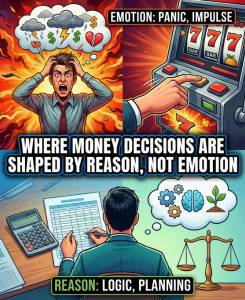
The Two Great Destroyers
Emotion in finance usually boils down to two distinct forces. We all know them. We all feel them. Greed is not just wanting money. It is the fear that someone else is making money faster than you. It happens when your neighbor buys a new boat and mentions a specific stock. It happens when you see a headline about a 1000% gain. Greed blinds you to risk. It makes you skip the due diligence. You buy because you want the feeling of winning, not because the math makes sense. This is how bubbles are formed. And bubbles always burst.
Fear (Panic)
Fear is the stronger emotion. Losing money hurts twice as much as gaining money feels good. This is “loss aversion.” When the market drops 10%, the rational brain says, “Stocks are on sale.” The emotional brain says, “It is going to zero.” Get out now. “Fear makes you sell low. It converts a temporary paper loss into a permanent actual loss.
The Behavior Gap
We can measure the cost of these emotions. It is called the “Behavior Gap.” Over the last 20 years, the S&P 500 has returned roughly 9-10% annually. So, the average individual investor has returned significantly less. Often 4-5%. Why? The investments didn’t perform worse for them. The investor performed worse.
They bought high (greed) and sold low (fear). They churned their accounts. Well, they paid fees. They reacted to the news. The gap between the market return and the investor return is the “emotional tax.”
It is the price you pay for letting your feelings drive the car.
Building the Rational Fortress
So, how do we fix this? We cannot lobotomize ourselves. We will always feel fear. The solution is not to eliminate emotion. The solution is to build systems that prevent emotion from touching the money.
We need a new architecture for decision-making.
Rule 1: The 24-Hour Cooling Period
This is a simple, unbreakable rule. Never make a significant financial decision on the same day you think of it. If you want to buy a stock, sell a fund, or buy a car, you must wait 24 hours. Write down the decision. Go to sleep. When you wake up, the dopamine or cortisol spike will have subsided. You will view the decision with your prefrontal cortex (logic), not your amygdala (emotion). 80% of the time, you will realize the decision was reactive. You won’t do it. You just saved yourself a fortune.
Rule 2: Automation as a Firewall
The best investor is the one who isn’t there. If you have to manually transfer money to your savings account every month, you are inviting a decision. “Should I save this month? Or should I buy the new iPhone?” That is a battle of willpower. Eventually, you will lose. Automation removes the battle. The money leaves your paycheck before it hits your account. It goes into the index fund automatically.
You don’t feel it. You don’t decide it. It just happens. This removes the emotion from the accumulation phase. You are dollar-cost averaging whether the market is up or down, without having to summon the
courage to click “Buy.”
Rule 3: The “Pre-Mortem”
Most people do a “post-mortem” after an investment fails. They ask, “What went wrong?” A rational investor does a “pre-mortem.” Before you buy an investment, assume it has already failed. Fast forward three years. The money is gone. Now, write down the story of why it failed. “I bought a tech startup, and it failed because regulation changed.” “I bought a rental property, and it failed because the neighborhood declined.”
This exercise forces you to look at the risks you are ignoring. It pierces the bubble of optimism. If you cannot explain why it might fail, you do not understand it well enough to buy it.
Rule 4: The Media Diet
Financial news is not designed to inform you. It is designed to agitate you. “Market in Turmoil.” “Crash Imminent.” “The Next Big Thing.” These headlines are engineered to trigger the amygdala. If you watch CNBC all day, you will be an emotional wreck. You will trade too much. Reason requires silence. Stop watching the daily news. Read quarterly reports. Read history books. The signal is in the long-term trend. The noise is in the daily ticker.
Rule 5: Goal-Based Buckets
Money is abstract. “Retirement” is a vague concept. When money is abstract, it is easy to gamble with.
Reason prevails when money has a job. Don’t just have an “investment account.” Have buckets with names. “The Daughter’s Wedding Fund.” “The 2035 Lake House Fund.”
“The Freedom Fund.” When you are tempted to sell your stocks because the market dropped, you aren’t
just selling “Account 8493.” You are selling “The Lake House.” Psychologically, that is much harder to do.
Connecting the money to a tangible goal anchors you. It reminds you of the horizon.
Rule 6: The “Sleep” Metric
Risk tolerance questionnaires are garbage. They ask, “What would you do if the market dropped 20%?”
On paper, everyone says, “I would buy more!” In reality, they panic. The only true metric of risk is sleep.
If you are lying in bed at 2 AM staring at the ceiling, worrying about your portfolio, you have too much risk. Period.
It doesn’t matter what the math says. It doesn’t matter that stocks “always recover.” If you can’t sleep, you will eventually make a bad decision to relieve the stress. You will sell at the bottom just to stop the pain.
The rational move is to reduce risk until you can sleep. Even if that means lower returns. A 6% return you stick with is better than a 10% return you abandon.
Rule 7: The Investment Policy Statement (IPS)
Institutions use an IPS. Individuals should too. This is a one-page document you write to yourself when you are calm. It states your strategy. “I buy low-cost index funds.” “Then, I rebalance when the allocation drifts by 5%.” “I do not buy individual stocks.” When the market crashes and you want to panic, you read the IPS. It is a letter from your rational self to your emotional self. This reminds you of the plan. It stops the drift. For more detail, check this article.
The Final Review
Moving from emotional money management to rational money management is a maturation process.
It is the transition from gambler to strategist. Yes, it is the transition from child to adult. It feels boring at first. There is no adrenaline rush in buying an index fund. There is no high in automating a savings transfer. But boring is where the wealth is.Excitement is expensive. Drama is for TV, not for banking. The goal is to reach a state of “financial stoicism.” The market goes up? Good. We stick to the plan. The market goes down? Good. We stick to the plan. We are not moved by the weather. So, we are moved by the destination. This is the only way to win. Not by being smarter than the market. But by being more disciplined than your own biology.
Disclaimer:
Look, Admin has been doing this a long time, but I’m a strategist, not your specific financial advisor or lawyer. The markets and regulations mentioned here, like the FinCEN rules or tariff situations, change faster than the weather. This article is meant to make you think strategically, not to replace professional advice tailored to your exact situation. Always do your own due diligence and consult with qualified professionals before making major moves.