There is a concept in business finance often referred to as the “loyalty tax.” It is the invisible, total premium paid simply because a management team is too busy to shop around. Organizations tend to stick with the same vendor, the same bank, and the same insurance (liability insurance) carrier because it works. The inertia of operations often overrides the necessity of auditing, leading to a dangerous assumption so that having a policy PDF in an inbox equates to being protected.
Forensic Review of Insurance Policy:
For the last four years, our firm auto-renewed its commercial insurance policies. It was treated like a utility bill, a fixed cost to be paid, not a variable risk to be analyzed. However, in the current financial year, after conducting a forensic review of exposure across our e-commerce and service divisions, it became evident that the business was walking a tightrope without a net.
- The findings were stark:
The business was not just overpaying; it was dangerously underinsured.
Primary macroeconomic forces:
The insurance market has shifted aggressively in recent years. Two primary macroeconomic forces: social inflation (the trend of nuclear jury verdicts). The second is AI-driven cyber threats have rendered standard business policies written prior to artificial intelligence obsolete.
Loops In Strategy:
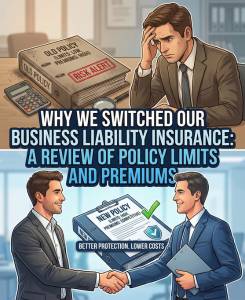
If a company is still holding a policy that was written before the rise of deepfake technology and the current inflationary cycle. It likely has structural holes in its coverage that will only be discovered upon the filing of a claim. This strategic review outlines why our firm fired its legacy carrier. Exactly how liability was restructured for the current market
The Trigger: The Inflation Gap.
Most business owners and CFOs assess insurance through the lens of premiums. The primary question asked during renewal season is usually, “Did the rate go up?” However, in our analysis, the more critical metric is the coverage-to-revenue ratio.
- When this business was founded, a $1 million General Liability (GL) limit felt like a fortress. It was the industry standard, and it provided a sense of absolute security.
- In the current legal environment, however, $1 million is a fence, not a fortress.
The Reality Of Social Rise:
The rise in prices has not only affected the cost of goods sold; it has fundamentally altered the courtroom. “Social rise” refers to the rising costs of insurance claims, not the social status of individuals. Resulting from increasing legal action, broader definitions of liability, legally friendly juries, and kind workers’ pay awards.
- The trend.
Settlement costs for standard claims—such as “slip and fall” incidents, product liability, or advertising injury—have risen roughly 25-30% in recent years. - Risk.
Consider a scenario where a business is sued for $1.5 million, a figure that is becoming increasingly common for severe injury claims involving long-term medical care.
Strategic Resolve: A simple way to manage rising costs.
To resolve this, the decision was made to switch to a carrier that offered an Inflation Guard endorsement.
Steps:
- This clause is a critical mechanism for growing companies. It automatically adjusts property limits by a set percentage (typically 4% to 8%) annually to match market reality and construction cost indices.
- This removes the administrative burden of calling the broker every time a new laptop is purchased.
- The policy grows organically alongside the business, ensuring that the “Replacement Cost” coverage actually covers the cost of replacement.
Non-Negotiable: Cyber Liability and AI.
This was the primary driver of the carrier switch. This sector of the insurance market has undergone the most risky change. The legacy policy included a cyber rider. This is a common, inexpensive add-on that general brokers often include to provide a false sense of security. It covered $50,000 for data recovery.
AI-driven Social Engineering:
The threat profile has shifted. Businesses are no longer just worried about a teenage hacker guessing a password; they are concerned about deepfake fraud and sophisticated social engineering.
- Scenario.
An accounts payable manager receives a phone call from the “CEO.” The voice sounds identical to the CEO. It uses the CEO’s specific cadence and phrases. - Denial.
When the fraud is discovered, a claim is filed. The legacy insurance provider denies the claim. Why? B - Voluntarily.
The employee voluntarily sent the money. There was no “hack” of the system; there was a manipulation of the human.
The Strategic Fix: Standalone Cyber Insurance.
Instead of relying on a rider, the firm purchased a specialized standalone cyber liability policy.
- Limits. The minimum acceptable limit was raised to $1 million.
- Key Clause. The new policy explicitly covers social engineering fraud, ensuring that funds lost due to employee deception are paid back.
- Digital Blackmail Negotiation. The policy includes a retainer for a professional blackmail negotiation team. If data is locked, the business management does not need to navigate the complexities
The “Sleep at Night” Layer: Umbrella Insurance.
In 25 years of market analysis, the trend of “nuclear verdicts,” jury awards exceeding $10 million, has exploded, particularly in the United States. Previously, the firm relied on a standard $2 million aggregate limit. But in the past, this was considered conservative and safe. Today, it is arguably the bare minimum for operation.
The New Strategy: The “Tower” Approach:
Because to move on a path to mitigate catastrophic risk, the firm purchased a $5 million commercial umbrella policy. Commercial umbrella insurance sits “on top” of the primary policies (general liability and commercial auto). But it remains dormant 99% of the time, only activating if a claim exceeds the limits of the primary policy.
Example:
The business is sued for $3 million following a severe accident.
- The primary policy pays the first $1 million.
- The umbrella policy activates to pay the remaining $2 million.
- Business Cash Outflow: $0.
How the Switch Was Executed
The process of finding the right coverage did not involve an online “instant quote” generator. While algorithmic quoting engines are efficient for freelancers or low-risk sole proprietorships. But they are often inadequate for scaling brands with employees, inventory, and complex digital footprints. Because these algorithms are designed to optimize for the lowest price, not the most comprehensive coverage.
Step 1: Ditch the Generalist.
The firm parted ways with its local “Main Street” broker. While the relationship was cordial, generalist brokers typically spend their time insuring restaurants, dry cleaners, and local retail shops.
- The Test. During the interview, the broker was asked, “So how does your carrier handle a pixel tracking privacy lawsuit?”
- The Result. The generalist was unfamiliar with the term. The specialist immediately began discussing “Regulatory Defense” sub-limits and recent class-action trends
Final Thought: The Cost of Doing Business.
Insurance is often viewed as a boring administrative hurdle until it is needed. But at that moment, it becomes the only thing that matters. So in the current market environment, operating a serious business on “economy” mode liability coverage is a gamble with asymmetric downsides. So, the market is too litigious, digital threats are too sophisticated, and the cost of legal defense is too high to self-insure.
Disclaimer:
I am a market strategist, not a licensed insurance agent or financial advisor. Insurance markets vary significantly by location (state/country) and industry. The premiums and limits mentioned above are for illustrative purposes based on a specific business profile (e-commerce/service mix). Business owners should always consult with a licensed commercial insurance broker to assess their specific risks and review their policy documents carefully. by admin